E.F. Schumacher, an English economist, is most famous for his work Small is Beautiful: Economics as if People Mattered. In this work Schumacher breaks with the traditional Neo-Classical model of economics--handed down to us by Adam Smith and David Ricardo, whose ideas have since been canonized in the annals of Western Capitalism--and argues for an international development paradigm that puts people before profit, and dignity before efficiency. One chapter, entitled Buddhist Economics, terminology coined by Schumacher himself, captures the essence of what a Buddhist economy might look like, an economy that values work with a human face and scale and seeks to maximize well-being with a minimum amount of consumption. Following is an attempt to present some of the main ideas of the essay; it is by no means a comprehensive analysis of the field of Buddhist economics or Buddhism itself, and I would encourage us all to read and re-read this insightful volume.
RIGHT LIVELIHOOD
The Buddha taught that there is an eight fold path that leads us toward a good life and away from suffering. One of these paths is right livelihood. Every able bodied man and woman should engage in some sort of work. Work is a source of joy and satisfaction to the doer, and provides a sense of dignity and self-reliance. In the Neo-classical model (NCM), labor which becomes a commodity that is bought and sold in the market is seen as an input or an expense that should be minimized. Schumacher writes, “Work and leisure are complementary parts of the same living process and cannot be separated with out destroying the joy of work and the bliss of leisure” (58). Thus what happens to work when we create machines that do it for us? This type of technology is seen as taking away from human dignity. Schumacher says that there are types of mechanization: mechanization which enhances mans abilities and talents, and that which takes his place (58). In his observation of poverty in South East Asia Schumacher observed that the principle of work could do much to create a just society, one that utilizes appropriate technology to put production in the hands of communities instead of centralized mega-corporation that mechanize production and create a vast workforce of laborers living on subsistence wages, doing work that is repetitive and not conducive to human creativity.
The NCM assumes that humans by and large are utility maximizers (Homo economicus); creatures that seek to maximize their utility through rational choices made in the perfectly competitive market place (a type of “market” that never has and never will exist). Again this abstraction fails to take into account the fact that most humans tend to cooperate and not compete, and act out of compassion and not individual utility derived from consumption of goods. Right livelihood teaches that we should engage in work because it is gratifying, not just to fill out pockets or bellies or to participate in a never ending cycle of conspicuous consumption.
SIMPLICITY AND NON-VIOLENCE
The two main emphases of Buddhist Economics are simplicity and non-violence. We may all be familiar with the idea of non-violence because of Mohandas K. Gandhi’s use of this tactic in the Indian independence movement. But non-violence goes far beyond the idea of avoiding physical violence. Simplicity and non-violence are ways of interacting with the rest of the world, and notions that help us to reduce our impact on the earth and the unnecessary suffering of others.
Buddhist economics views consumption as a means to the end of well-being. Thus maximum well-being is sought from minimum consumption. In the NCM, consumption is seen as the end, with the factors of production—land, labor, and capital as the means (61). Schumacher writes, “The ownership and the consumption of goods is a means to an end, and Buddhist economics is the systematic study of how to attain given ends with the minimum means” (61). In a classic Buddhist mind set, attachment to wealth is seen as a hindrance to liberation from wants. Simplicity naturally follows the desire to be free from wants, as opposed to a consumer society which insists that freedom is only guaranteed by access to more and more things.
One of the five precepts of Buddhism is non-violence, envisioning an economy with this principle in mind may seem utopian to us, but as we can see the global economy has dealt more than its share of violence to humans, non-humans, and our ecologies, as a result of expanded commodification of life, and dislocation of communities from the means of production. Our dinner plates and the clothes on our backs all have a secret past that for the most part is out of harmony with the principles of simplicity and even basic compassion. Sweat shops and factory farms are taking terrible tolls on the land and the people who must labor there. But because their production takes place out of sight and out of mind, and because consumers are mostly denied information about the products we buy, consumers are greatly unaware of the suffering that occurs in the production of every meal and every garment. As consumers it is part of our duty to better understand the supply chain that provides us with our daily bread. If we are to be truly concerned with the well-being of others and of ourselves we must not support industries that contradict our values. We must begin to incorporate all of our actions into a cause and effect paradigm that recognizes the ecology of living on a small planet. Every thing is connected to everything else!
LOCAL RESOURCES FOR LOCAL NEEDS
The mantra of Buddhist economics is, “local resources for local needs.” Because Buddhist economics tries to maximize well-being through minimum consumption and toil, it would be logical that needs be met at the local level. Here there is more information available to the consumer, and far less energy is needed to carry goods from producer to consumer. This makes both economic and ecological sense. Just as countries try to import less than they export, communities can strengthen local economies by producing locally. Most Americans consume food that was produced thousands of miles away, carrying with it a burden of fossil fuel consumption that is not reflected in the prices of goods. Diversification and organic production also have positive benefits for the environment and communities. Diversifying crops increases the number of other forms of life around the crops and comes much closer to an actual ecosystem than massive mono-crop industrial farms, and does not expose humans or non-humans to harmful chemicals typically employed in industrial farming.
After reading Schumacher’s work I would like to consider myself a Buddhist Economist. Living simply and in harmony with the earth has a myriad of bebefits both for the soul, the community and the world. In order for us to solve the host of problems that have been created and passed down to us by faulty economic assumptions (among other factors of course), we must become more eco-literate, and better understand that everything is connected and that all of our choices have consequences, especially our consumption habits. There are many things we can do to live in greater harmony with the earth and reduce unnecessary suffering. Growing our own food is probably the best option, which can be done in small plots or in community gardens. Learning skills that can be shared within the community like carpentry or sowing can be sources of work and dignity exchanged at the local level. Reducing the amount of meat we consume, and purchasing more organic fruits and vegetable, locally if possible, will also have a positive impact on both the community and the environment. Becoming a Buddhist economist doesn’t require withdrawal from society (although sometimes the commune life sounds pretty inviting). It starts with an increased awareness of the impact of our lifestyles on other beings (not just humans), and a commitment to do the extra work in avoiding habits that are destructive. It is about living simply and finding happiness therein.
Here is a basic summary of Buddhist economic principles.
People before profits
Local resources for local needs
Simplicity and non-violence
Minimum consumption for maximum well-being
For more information on Buddhist economics, and ecological economics check out these websites…
www.redefiningprogress.org
www.smallisbeautiful.org
www.ecoeco.org
www.truecosteconomics.org
www.squarefootgardening.com
REFERENCES
Schumacher, E.F. 1989. Small is Beautiful Harper Perennial, New York
Thursday, February 02, 2006

Saturday, January 14, 2006
who said stewarship had to be geometric?
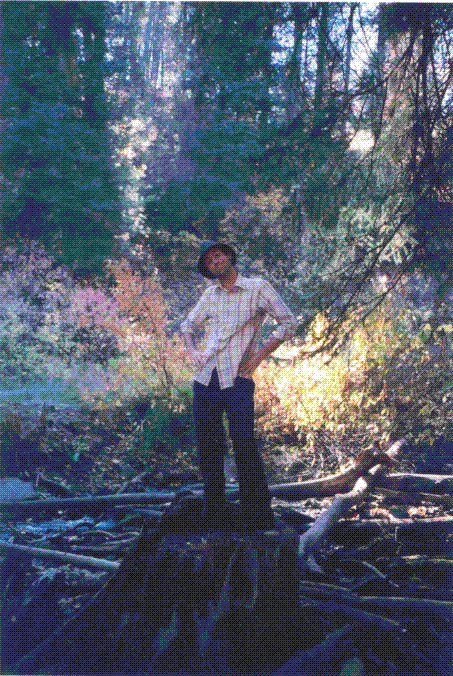
Who said Stewardship had to be Geometric?
Who said stewardship had to be geometric?
Right angles pastels patterns and flowerboxes
The wild meander of wild rivers compartmentalized by the ax and gun of man
Groves to clearings, green to brown, chaos to order
The least we could have done was ask permission
Patterns and stick figures like feet on the sand, leaving a mark that fades away with the tide
Only this time the tide has retreated leaving our many footprints like scars on the land
Oh Humans, is it really you as far as the eye can see?
Grids like graphs divide the land into dollar signs, slumps and curves.
The rules of nature became the exceptionÂ…
Small strips of untamed land, dark rivers with tears of silt
My catalogue whispers reassurances; all this was not for nothing.
Just leave your name on this 3x5 card and we will take care of it for you.
18/2/05 in a plane to Chicago
Big Sur
I stood in a grove of red wood trees surrounded by moss and moisture and almost forgot that there were suburbs next door, that down south the earth was dying under the weight of the species I owe my consciousness to.
The sun rose and silhouetted small farms, not shopping malls with similar names, or ranches that arenÂ’t ranches at all.
HWY-15 just south of Provo As I emerged from the electric grids of a suburb, headed for another just like it, I slowly slipped into an expanse of floating white fog that extended infinitely on both sides of the road. As infrastructure faded I passed through time to small farms and age sagged silos giving in to gravity. Thought the natural landscape had long since been vanquished the open space was a relief. As the sun began to break through the fog I could make out rows of apple trees whose leaves had been shed and whose branches slumbered till the spring. I imagine the days when the first people roamed these lonely hills in search of sustenance. They too have yielded under the weight of my civilization, and not inevitably it seems but unfortunately.
Orange County intersection of Bastanchury and Lakeview.
its strange that only five years ago this master planned upper-middle-classuburbanan compound was a grove of orange and avocado trees. it had probably been that way for a hundred years. before that it was a natural space with trees and animals an ecosystem. usually its the old folks who talk about what used to be, when they were young, but i'm still young and progress is moving to fast for me.
Tuesday, January 03, 2006
the first lines of manifesto
I think I've actually written several manifestos in my life. Ya, I take myself way to seriously, and each time they turn out a little different. I remember in one I swore before God and angels that I would never own a fancy car, or a mini-van. That I would always be a punk rocker. That's funny, cuz I never really was a punk rocker, I just though I looked like one for about three years. And because I inherited some Dead Kennedy tapes from my aunt. From then on I would spend all my allowance on spike bracelets and music I thought a punk should own. After my time in the Dominican Republic (two years as a mormon missionary) I mellowed out a bit and gave up art as a career option and started in on anthropology. I don't think I will ever give up on the idea of creating art, I just didn't want to have to make money doing it. This whole barefoot anthropology thing came to me in a Nancy Scheper-Hughs article assigned to me in a theory class. She suggested that anthropologists might consider actually caring for those with whom they work. It turns out I don't actually want to make money doing anything, so living like a peasant is quite appealing to me, without all the socio-political disadvantages of course ( I am a romantic remember). There's always exploitation in time clocks no matter who is punching them so why not live without them, pretty simple I thought. So below are some points on which life may seem less mysterious and perilous. Not even close to what I have in scores of moleskin journals, but its a start.
anyways here goes:
1. I want to write, no matter how horrible or boring or serious I get.
2. I want to photograph, my soul has never been as warm as it has been looking into the eyes of a brand new photograph which I created with the help of technology (which I grudgingly thank at times).
3. I want to live beautifully, and as E.F. Schumacher believes Small is Beautiful. So whatever that means I hope I can make it happen, though I am notoriously distracted by large tracks of land in the country and Spanish architecture.
4. Music
5. I was born Mormon, but I struggle with organized religion like a cow thrown in a lake. But if I can just live as closely to the Sermon on the Mount as possible I think I'll be ok. (Tolstoy and Vonnegut may agree).
6. I want to be able to call my community a village, for whatever romantic reasons, community appeals to me, all though I am hopelessly misanthropic, I hope its just a phase, it's been one of my longer ones I hate to admit, and I'm pretty sure I can trace its roots back to a period of Kurt Cobain worship that hit just after puberty.
to be continued...
anyways here goes:
1. I want to write, no matter how horrible or boring or serious I get.
2. I want to photograph, my soul has never been as warm as it has been looking into the eyes of a brand new photograph which I created with the help of technology (which I grudgingly thank at times).
3. I want to live beautifully, and as E.F. Schumacher believes Small is Beautiful. So whatever that means I hope I can make it happen, though I am notoriously distracted by large tracks of land in the country and Spanish architecture.
4. Music
5. I was born Mormon, but I struggle with organized religion like a cow thrown in a lake. But if I can just live as closely to the Sermon on the Mount as possible I think I'll be ok. (Tolstoy and Vonnegut may agree).
6. I want to be able to call my community a village, for whatever romantic reasons, community appeals to me, all though I am hopelessly misanthropic, I hope its just a phase, it's been one of my longer ones I hate to admit, and I'm pretty sure I can trace its roots back to a period of Kurt Cobain worship that hit just after puberty.
to be continued...
Subscribe to:
Posts (Atom)