For the last several years I have tried to commemorate
the solstice with at least some acknowledgement of this our longest day of the
year. Nothing to New Agey, ritualistic or woo-woo; solitude, a hike, etc. This
year I awoke early and watched the eastern sunrise from my Forest Service
station at the Mill Hollow Guard Station east of Heber, Utah. As I watched I
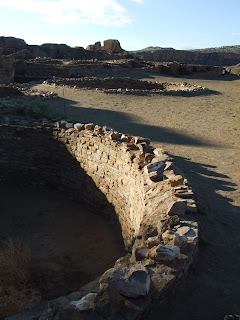
thought of the trip I had recently made to the Chaco Canyon Pueblos in New
Mexico where the Puebloan peoples that lived there for approximately 1,000
years developed an elaborate sun, moon and star watching practice. It is
thought that the astronomy of these people developed to plan festivals and
trade fairs that were held each year and which were attended by thousands of
people from all over the region. Being able to predict the cycles of the sun and
moon in their ascent and descent in the sky were essential aspects of everyday
life because Chaco was the ceremonial center of this brief empire that
synchronized trade and streamlined architecture into the uniform masonry that
the Chaco ruins reflect. The sun and moon were meticulously watching using
simple instruments like a stick in the ground whose shadow was measured each
day to orient the villages along a north-south axis. Natural monuments such as
Chimney Buttes and small cracks in the rocky mesas were used to track the
journey of the Sun high into the summer sky and back to its winter nadir.
How little I know about the cycles of the sun, moon
and stars. They have been mostly eclipsed, so to speak, by our more precise
technological time pieces and secular calendars. I struggle to remember whether
the moon is waxing or waning. I sometimes notice the ascending and receding
position of the sun throughout the year, but am never still enough, in one
place long enough to watch it actually change. Yet, on the solstice I try to be
present to this silent but ever present liturgy as the sun rises and sets,
ascends and descends in the sacred sky.
On this particular solstice I didn’t do anything
that different. I watched a spotted sandpiper drunkenly walk the shore of the
creek near the cabin. I listened to unknown birds call from hidden bows of a
nearby aspen wood. I watched the slow advance of a beaver logging operation on
the other side of the creek. I walked endlessly through forests that were being
ravaged by spruce beetles; the sappy trunks of towering trees smattered with
the frass and pitch of fresh beetle entries and exists. The tall, ancient boles
whose glory fades one needle at a time; from green to faded brown.
The spruce beetle (Dendroctonus rufipennis) is such a small creature having
such a huge impact on a place. I am reminded of us; our voracious appetite for
material things, money and comforts is killing the earth upon which we have
evolved, lived, loved, laughed and learned. And just as the beetle knows
nothing else but to eat, mate and reproduce; we too, despite our supposed
enlightened minds, technological prowess and religious moralities are eating
ourselves out of house and home. And like the beetle, when the trees run out,
we may very well face a crash. I hope we have the strength to buck this
powerful evolutionary urge and course correct. Perhaps we will, and perhaps we
will not. Yet on this solstice, even under the fading green of spruce trees fighting
to stay alive, I have hope that we too will survive, that the trees will grow
back and that a balance will be struck.


